
Catamaran v fishing boat off Mallorca: the CIAIM report
A 23 m catamaran and a 7 m fishing boat collided in good visibility off Mallorca. What the CIAIM report says and which COLREGs rules come into play.
A 23 m pleasure catamaran and a 7 m fishing boat collided in good visibility, with a light wind and seas between ‘rizada’ (rippled) and ‘marejadilla’ (smooth, Douglas degree 2), two nautical miles from Punta Salinas. According to the report by Spain’s maritime accident investigators (CIAIM, the Comisión Permanente de Investigación de Accidentes e Incidentes Marítimos), neither skipper realised there was a risk of collision until it happened.
The report is a technical safety investigation. The CIAIM says it does not prejudge any court decision and does not seek to assess liability or establish blame. We use it here to learn the rules, not to judge anyone. The rules are the international collision regulations (COLREGs, known in Spain as the RIPA), and the case touches on rules 5, 7 and 15.
The incident at a glance
- west of Punta Salinas, Palma de Mallorca
- 2nautical miles
- catamaran’s speed, on autopilot
- 8knots
- time of the collision, according to the report’s account
- 06:42
- AIS point that matches the collision position
- 06:41
- Conditions: light wind, sea between ‘rizada’ (rippled) and ‘marejadilla’ (smooth), significant wave height 0.1 to 0.3 m, visibility of 10 km or more; sunrise was at 06:33
- Consequences: the fishing boat sank; scratches on the catamaran’s starboard bow; no injuries
- Investigation: CIAIM-12/2025, published in May 2026
- Report: source of the data: Ministerio de Transportes y Movilidad Sostenible (CIAIM). Report published in May 2026; accessed on 15 October 2026.
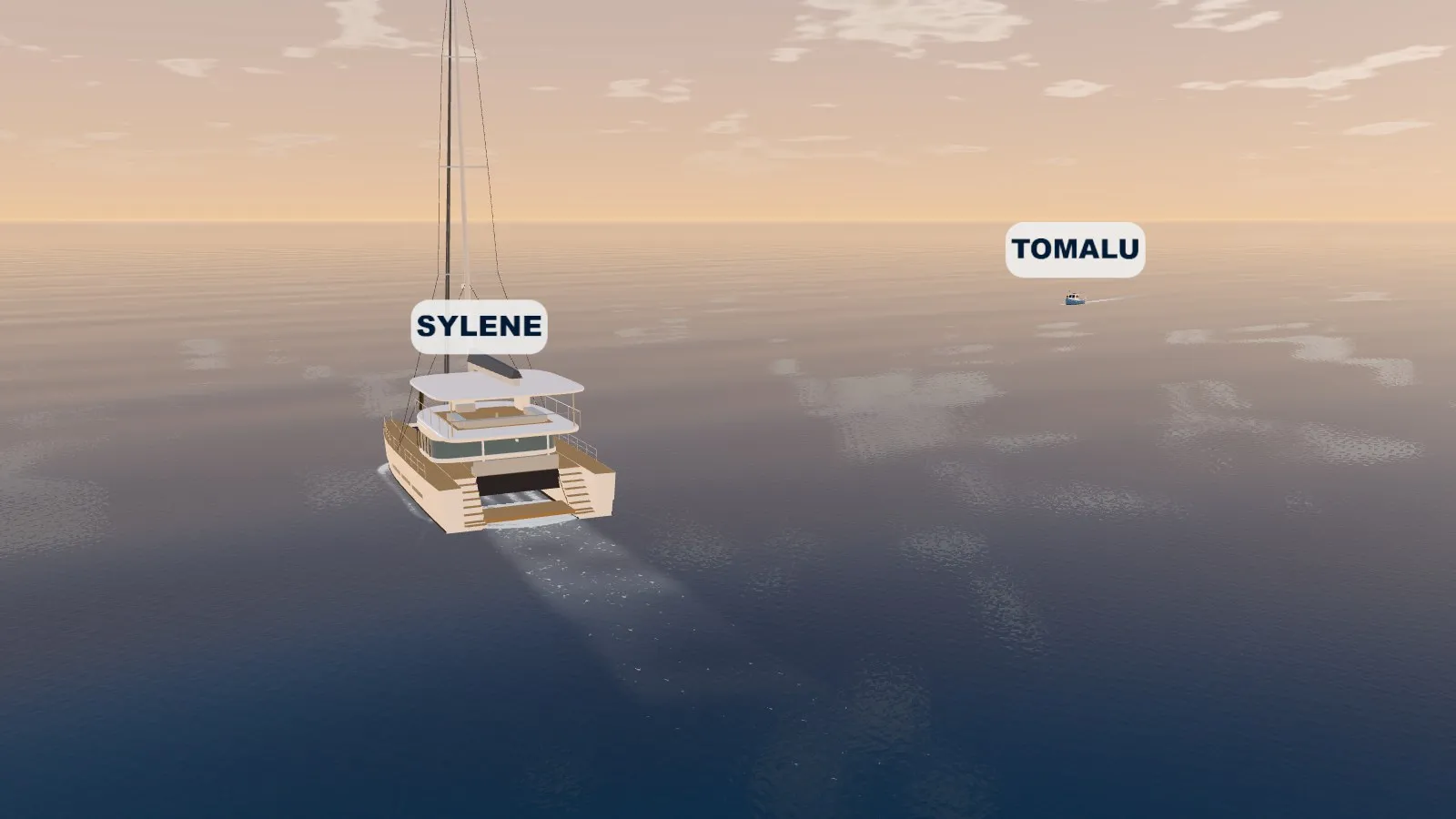 Illustrative reconstruction
 Illustrative reconstruction.
- Data:
- the track, time, speed and heading of SYLENE (and its heading arrow), from the AIS points in the report; between two points, the values are interpolated.
- Report hypothesis:
- where TOMALU was and how it was moving; its distance, its bearing, the line that shows them and its heading arrow depend on this.
- Illustration:
- the models of the boats, the sea and the clouds; the sun is calculated for the date, time and place.
- Not in the report:
- the amount and shape of the cloud (the report says only “nublado”, that is overcast, §2 and §3.3) and the wind direction (the data sheet says south-east and §2 says south-west); the scene shows both in a neutral way.
- 06:35 The catamaran is making 8 knots on a heading of about 295° according to the AIS points (the report’s text says 290°). The skipper says they saw a small boat half a mile to starboard, which did not show on radar or AIS, and another echo about 3 miles ahead.
- 06:38 The catamaran’s AIS data show the start of the turn to port and the drop in speed.
- 06:41 The AIS point that matches the collision position given in the report.
Decision points, as text
≈06:35. A boat in sight and a distant echo.
What happened: The skipper on watch was supervising from the interior helm position on the main deck, with limited visibility; the catamaran was making about 8 knots on autopilot. The skipper says they saw a fishing boat of about 7 or 8 m roughly 0.5 nautical miles to starboard, which showed on neither AIS nor radar, and another echo about 3 nautical miles ahead. They focused on that intermittent echo and stopped paying attention to the fishing boat.
What the report says: The report concludes that the collision resulted from an ineffective look-out and describes the skipper giving priority to a distant radar echo and neglecting the nearby boat that was in sight. (CIAIM report, §2, §3.2, §4)
Rule that comes into play (our analysis) and lesson: Rule 5 comes into play: it requires a proper look-out by sight and hearing, and by all available means appropriate in the prevailing circumstances. Course lesson: Look-out, speed and risk
Between ≈06:35 and the collision. Course and speed unchanged.
What happened: According to the report’s account, the catamaran kept course and speed (about 8 knots) on autopilot. The fishing boat did not show on the catamaran’s radar or AIS. The catamaran’s AIS points show an almost constant course and speed until 06:36:46 and, from 06:38:16, a turn to port and a drop in speed (table 1).
What the report says: The report notes that the skipper did not reduce speed, did not strengthen the look-out and did not switch to hand steering, and that the fishing boat’s size and wooden hull limited detection by radar. (CIAIM report, §2, §3.1, §3.2, §3.3)
Rule that comes into play (our analysis) and lesson: Rule 7 comes into play: if there is any doubt, risk of collision is deemed to exist, and assumptions shall not be made on the basis of scanty information, especially scanty radar information. Course lesson: Look-out, speed and risk
Between ≈06:35 and the collision. Crossing situation.
What happened: The report could not determine whether the fishing boat was stopped or under way: two hypotheses are possible, and you can switch between them in the reconstruction.
What the report says: In its conclusions, the CIAIM takes a crossing situation to have existed, in which the catamaran saw the fishing boat on her starboard side, and concludes that the SYLENE should have given way. (CIAIM report, §3.1, §4)
Rule that comes into play (our analysis) and lesson: Rule 15 comes into play: when two power-driven vessels cross so as to involve risk of collision, the one that has the other on her starboard side keeps out of the way (the give-way vessel, Rule 16; the other is the stand-on vessel, Rule 17). Course lesson: Who gives way?
06:42 according to the account; AIS point at 06:41:16. The manoeuvre at about 10 m.
What happened: The skipper saw what looked like the wheelhouse roof of a vessel on the starboard side, about 10 m from the bow; they turned hard to port and went astern at full power. According to this account, the catamaran’s starboard hull struck the fishing boat’s port bow, and she sank quickly; the conclusions (§4) say the catamaran collided “con su proa” (with her bow) with the fishing boat “en su costado de babor” (on her port side; our translation). The fishing boat’s two crew had gone out to fish for squid with jigs.
What the report says: According to the report’s account, the skipper manoeuvred on seeing the wheelhouse of a vessel about 10 m from the bow. The report notes that the fishing boat’s skipper did not see the catamaran until the impact and concludes that they should not have neglected the look-out. (CIAIM report, §2, §3.2, §4)
Rule that comes into play (our analysis) and lesson: Rule 5 comes into play again: it applies to every vessel, the fishing boat included. Course lesson: Look-out, speed and risk
The catamaran’s movement follows its twelve AIS points (table 1 of the report). The report gives two directions for the light wind: south-east in the data sheet (130° to 150°) and south-west in the text (§2), and it does not explain the difference; the scene draws the sea with the data sheet’s direction. The fishing boat’s position before the collision is not in the report: it is drawn according to one of the report’s two hypotheses, which you can switch, and is not presented as data. The decision points on the timeline summarise what the report says and the rules that come into play; their position on the timeline is approximate, and the time the report gives is shown on each one.
Illustrative reconstruction by Náutica Visual from the data in CIAIM report 12/2025. The position and movement of the fishing boat are hypotheses. It does not reproduce the events exactly, does not replace the official report and does not determine liability.
The map shows the catamaran’s twelve AIS points between 06:24 and 06:42 as an almost straight line to the north-west on a steady course, with a sharp turn to port in the last points, where the point of impact is marked. Two possible positions of the fishing boat are drawn as dashed lines labelled ‘report hypothesis’: stopped ahead of the catamaran, or under way from starboard. The report does not determine which is correct.
Illustrative reconstruction by Náutica Visual from the data in CIAIM report 12/2025. The position and movement of the fishing boat are hypotheses. It does not reproduce the events exactly, does not replace the official report and does not determine liability.
Timeline
All times are local and come from the report.
- 23:00The previous dayThe catamaran sails with watches; at 05:00 the skipper takes over the watch from the interior helm position on the main deck.CIAIM-12/2025 report, §2
- 05:30TOMALU leaves her home port, on the south of Mallorca, with two people to fish for squid with jigs.CIAIM-12/2025 report, §2
- ≈06:35The skipper sees a fishing boat of about 7 or 8 m, roughly 0.5 nautical miles to starboard, which shows on neither AIS nor radar. The skipper also sees another echo about 3 nautical miles ahead. The skipper focuses on that intermittent echo and stops paying attention to the fishing boat; the skipper keeps course and speed and uses neither VHF nor sound signals.CIAIM-12/2025 report, §2
- 06:42The skipper sees what looks like the wheelhouse roof of a vessel on the starboard side, about 10 m from the bow. The skipper turns hard to port and goes astern at full power. According to this account, the starboard hull of the catamaran strikes the fishing boat’s port bow, and she sinks quickly; the conclusions (§4) say the catamaran collided “con su proa” (with her bow) with the fishing boat “en su costado de babor” (on her port side; our translation).CIAIM-12/2025 report, §2
- 06:44The coordination centre receives the alert from the fishing boat’s emergency beacon (06:44) and, later, the call from the catamaran itself (06:52).CIAIM-12/2025 report, §2
- 07:33The catamaran lands the two fishermen at their home port and, at 07:45, continues to Palma.CIAIM-12/2025 report, §2
The report puts the stated sighting at about 06:35 and the collision at 06:42, and notes that less than four minutes passed between the two. The catamaran’s AIS data show the turn to port from 06:38 (table 1). We give the figures as they appear in the report, without proposing an explanation.
Which COLREGs rules come into play
This section is our own teaching analysis, not a conclusion of the CIAIM. The report does not cite rule numbers and does not say that any rule was broken. Its conclusions are the three in section 4: the collision resulted from an ineffective look-out, the SYLENE should have given way, and the TOMALU’s skipper should not have neglected the look-out. Each card explains what the rule says in the collision regulations (COLREGs; Spain’s official text is the RIPA, BOE-A-1977-15605) and which item in the report relates to it, so you can go on to the matching course lessons. The cards summarise the wording of the international text; the report itself is in Spanish.
Rule 5: Look-out
- What it means
- Requires a proper look-out by sight and hearing, and by all available means appropriate in the prevailing circumstances.
- What happened
- The report speaks of an ineffective look-out and describes the skipper giving priority to a distant radar echo and neglecting the nearby boat in sight; it also says the fishing boat’s skipper should not have neglected the look-out.
Rule 7: Risk of collision
- What it means
- If there is any doubt, risk of collision is deemed to exist.
- What happened
- The report states that, with the fishing boat either stopped ahead or under way from starboard, there was objectively a risk of collision.
Rule 15: Crossing situation
- What it means
- When two power-driven vessels cross, the one that has the other on her starboard side keeps out of the way. That is the give-way vessel (Rule 16); the other is the stand-on vessel (Rule 17).
- What happened
- The CIAIM takes a crossing situation to have existed, with the catamaran seeing the fishing boat on her starboard side, and concludes that the SYLENE should have given way; earlier it acknowledges that it could not determine whether the fishing boat was stopped or under way.
What measures the report mentions
Only what is in the report; this is not a list of what ‘would have prevented’ the collision:
- Watch from the upper helm position. After the accident, the catamaran’s watches moved to the upper-deck helm position, which has better visibility.
- Hand steering. The report notes that the skipper did not switch to hand steering.
- Speed and look-out. The report notes that the skipper did not reduce speed and did not strengthen the look-out.
- A warning by VHF or other means. According to the report’s account, the catamaran gave no warning. The report adds that the fishing boat’s skipper, had they noticed the catamaran, could have given a warning by VHF or another means.
- A radar reflector. The report says that the fishing boat’s size and wooden hull limited detection by radar, which a radar reflector could have mitigated. In the course you will see what one looks like and why it is fitted high up:
03-safety-at-sea/06-safety-equipment.
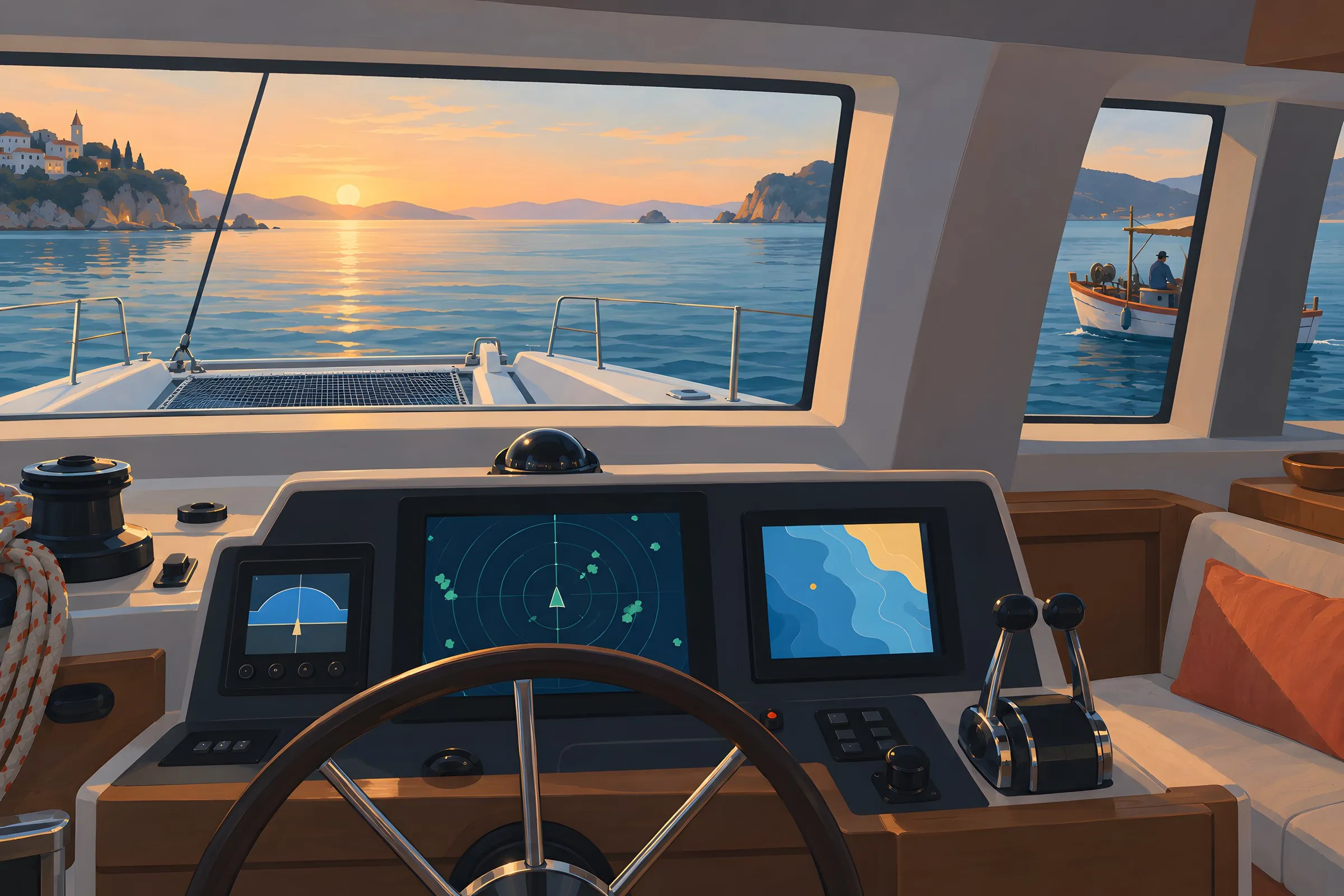
Two hypotheses about the geometry
The report does not record the fishing boat’s track. From the statements and the table of AIS positions (twelve points), it concludes that only two situations are possible and that it was not possible to determine which one occurred:
- The fishing boat was stopped. In that case she would have been ahead of the catamaran, not on her starboard side.
- The fishing boat was under way and it was a crossing, with her on the catamaran’s starboard side.
In its conclusions, the CIAIM takes a crossing situation to have existed. We add no version of our own.
How we did this analysis
We started from the CIAIM’s official report and used no other sources for the facts. We include no names of people or registration numbers. The vessels’ names are those in the public report. We say no more about who owns or crews them than the case requires. Statements about the facts are the report’s and are attributed to it; the COLREGs analysis is our own teaching exercise and has no value as a formal or legal opinion. The reconstruction and the map are illustrative: they use the coordinates in the report’s table, but the position of the fishing boat and of other references is approximate. We use no figures or photographs from the report. The report states that its preparation does not prejudge any court decision and does not seek to assess liability or establish blame. This article was not prepared, endorsed or sponsored by the Ministerio de Transportes y Movilidad Sostenible or the CIAIM. Date accessed: 15 October 2026.